
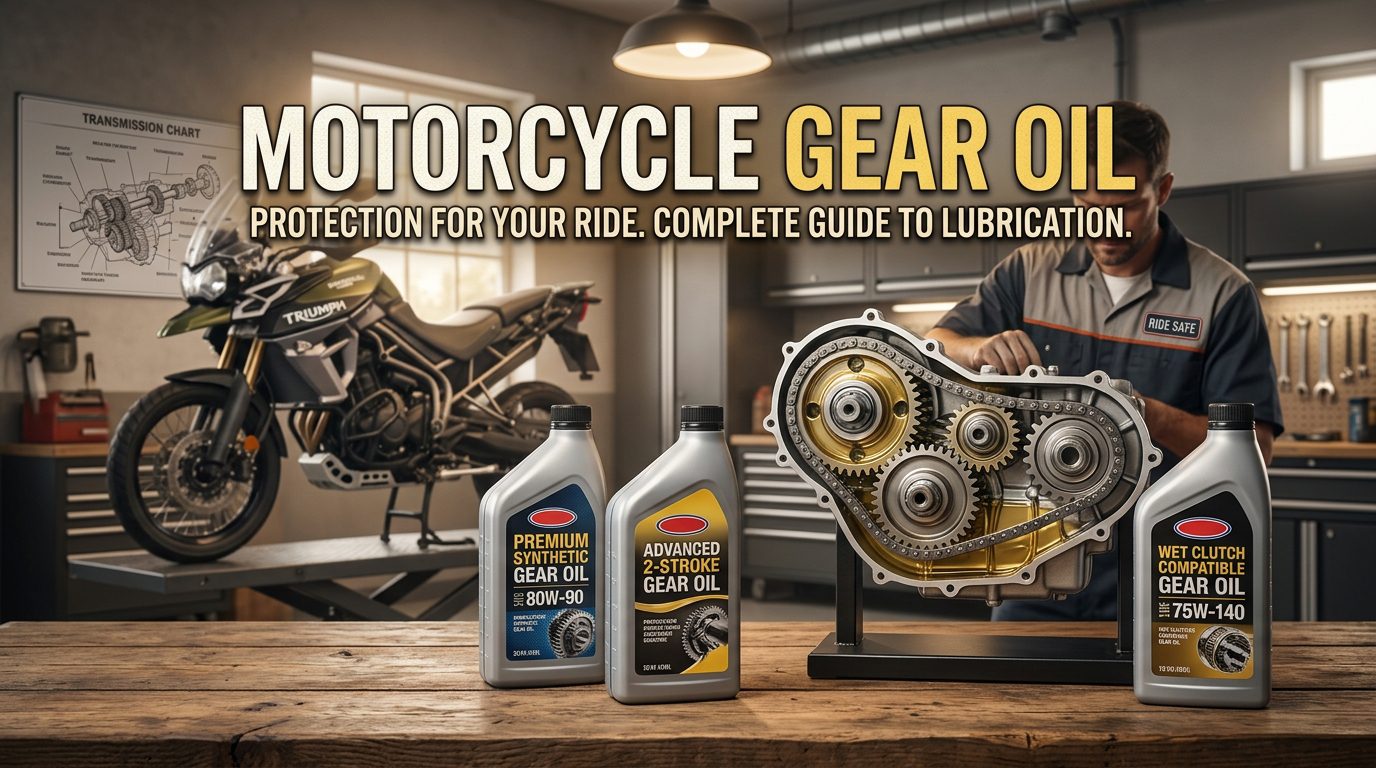

Many riders know they need to change their engine oil regularly. But what about motorcycle gear oil?
Gear oil is also important for motorcycles that use a separate gearbox or final-drive oil. It helps protect gears and other internal parts from friction and wear.
If you do not know when to change your gear oil or which type to use, don’t worry. This guide explains it in simple terms.
What Is Motorcycle Gear Oil?
Motorcycle gear oil is a lubricant used to protect gears and bearings inside certain motorcycle transmissions and final-drive systems. Its main job is to reduce friction between moving metal parts. It also helps protect these parts from wear.
However, not every motorcycle uses gear oil in the same way. For example, some motorcycles have a separate gearbox or final drive that uses gear oil. Other motorcycles have the engine, clutch and gearbox in one system and use motorcycle engine oil that meets the manufacturer’s specifications.
This is why you should always check your motorcycle owner’s manual before buying oil.
Purpose of gear oil motorcycle?
Good-quality gear oil helps:
- Reduce friction between gears
- Protect gears from wear
- Reduce heat caused by friction
- Keep the transmission or final drive working smoothly
- Protect internal metal parts from corrosion
In simple terms, the right oil helps your motorcycle’s gears work smoothly and stay protected.
Why Is Motorcycle Gear Oil Important?
When you accelerate, change speed or put your motorcycle under a heavy load, the gears experience pressure and friction. Without enough lubrication, the metal parts can wear faster. Old, dirty or low oil may also reduce the protection available to the gears.
Over time, this can lead to problems such as:
- Unusual whining or grinding noises
- Rough operation
- Oil leaks
- Excessive heat
- Faster wear of internal components
However, these symptoms can have many different causes. If your motorcycle starts making unusual noises, it is better to have it checked by a qualified mechanic instead of assuming the gear oil is the problem.
Regular maintenance can help prevent bigger problems
Changing oil is usually much cheaper than repairing damaged components. That is why it is better to follow the maintenance schedule in your motorcycle owner’s manual. A simple oil change at the right time can help keep your motorcycle running reliably.
Motorcycle Gear Oil vs Engine Oil
One common question is:
“Can I use engine oil instead of gear oil?”
The answer is: do not assume they are interchangeable.
Engine oil and gear oil are designed for different applications. Engine oil is designed to lubricate engine components such as pistons, bearings and other moving parts whilw the gear oil is designed to protect gears and bearings in applications that require gear lubricant.
Some motorcycles, however, use the same engine oil to lubricate the engine, clutch and gearbox. So the correct oil depends on your motorcycle.
Always check your motorcycle’s specifications
Your owner’s manual will normally tell you:
- Which type of oil to use
- The recommended viscosity
- The required oil specification
- How much oil is needed
- When the oil should be changed
If you are unsure, ask a motorcycle mechanic before adding oil. Using the correct oil is more important than simply choosing the most expensive oil.
Understanding Gear Oil Grades
When shopping for gear oil, you may see numbers such as:
- 75W-90
- 80W-90
- 75W-140
You may also see specifications such as API GL-4 or API GL-5. These numbers and specifications can look confusing at first. Let’s make them easier to understand.
What Does 75W-90 Mean?
The numbers describe the oil’s viscosity. For example, 75W-90 has two viscosity ratings. The first number, 75W, relates to how the oil flows at lower temperatures. The second number, 90, relates to its viscosity at higher operating temperatures. Similarly, 80W-90 is a different viscosity grade.
75W-90 vs 80W-90
Both are commonly used gear-oil grades, but they are not automatically suitable for every motorcycle.
In general:
75W-90
- Flows more easily at lower temperatures
- Can provide good protection across a wide temperature range
- Commonly used in various automotive and motorcycle applications
80W-90
- Has a different low-temperature viscosity
- Commonly used in many gear and final-drive applications
- Can be suitable for warm climates when specified by the manufacturer
For riders in Malaysia, temperature is only one factor to consider.
Do not choose 80W-90 simply because Malaysia is hot.
The manufacturer’s recommended viscosity should come first.
What Are API GL-4 and GL-5?
You may also see API GL-4 and API GL-5 printed on gear-oil bottles. These are gear-lubricant performance classifications. They are designed for different applications, so they should not be treated as automatically interchangeable.
API GL-4
GL-4 oils are commonly used in certain manual transmission and gear applications where the manufacturer specifies this level of protection.
API GL-5
GL-5 oils are designed for applications that require a higher level of extreme-pressure protection, including many final-drive applications.
But that does not mean GL-5 is always better for every motorcycle.
Some components and transmissions require a particular oil specification.
The important rule
Follow your motorcycle manufacturer’s specification.
Do not choose an oil simply because it has a higher number or sounds more powerful.
The correct oil is the one that matches your motorcycle.
When Should You Change Motorcycle Gear Oil?
There is no single change interval that works for every motorcycle.
The correct interval depends on:
- Motorcycle model
- Transmission or final-drive design
- Oil specification
- Riding conditions
- Manufacturer’s recommendations
Some motorcycles may require gear oil changes at relatively short intervals, while others may have different service schedules.
That is why the owner’s manual should be your first reference.
What if you cannot find the recommended interval?
If you are unsure, check your motorcycle’s service manual or ask a qualified motorcycle mechanic.
Avoid following a random interval from another motorcycle because the specifications may be different.
How Do I Know If My Gear Oil Needs Attention?
You should not wait until your motorcycle develops a serious problem before checking its oil.
Some possible warning signs include:
1. Unusual noises
A new whining, grinding or other unusual noise from the transmission or final-drive area should be checked.
2. Oil leakage
Look around the relevant gearbox or final-drive area for signs of oil leakage. Low oil levels can reduce lubrication and protection.
3. Unusual oil condition
When the oil is drained, a mechanic can inspect its condition. Very dirty oil, excessive metal particles or an unusual smell may indicate that the system needs attention.
4. Changes in motorcycle performance
If you notice unusual vibration, noise or rough operation, do not immediately assume that changing the oil will solve the problem. There may be another mechanical issue. A proper inspection can help identify the actual cause.
How to Choose the Right Motorcycle Gear Oil?
Choosing gear oil does not have to be complicated.
There are three things you should check.
1. Check the owner’s manual
This is the most important step.
Look for the recommended:
- Viscosity
- API classification
- Oil type
- Quantity
- Change interval
Write down these specifications before buying your oil.
2. Check your motorcycle’s design
Different motorcycles use different lubrication systems. For example, some motorcycles use a separate final-drive lubricant. Others use engine oil for the engine, clutch and gearbox.
Some scooters also have separate final-drive gear oil. So never assume that all motorcycles use the same oil.
3. Consider your riding conditions
Your riding conditions can also affect maintenance. For example, frequent long-distance riding, heavy loads, stop-and-go traffic or other demanding conditions may require more attention to maintenance. But again, your manufacturer’s recommendations should come first.
Mineral vs Synthetic Gear Oil
You may also see different types of gear oil, such as mineral and synthetic.
Mineral gear oil
Mineral oil is a conventional type of lubricant. It can be a suitable and economical choice when it meets your motorcycle manufacturer’s specifications.
Synthetic gear oil
Synthetic oil is formulated to provide consistent performance across a wider range of conditions. Depending on the application, it may offer advantages such as good temperature stability and resistance to breakdown.
However, more expensive does not automatically mean better for your motorcycle. The most important thing is to use an oil that meets the required specification. If your motorcycle manufacturer recommends a particular type, follow that recommendation.
How to Check Your Gear Oil?
The exact method depends on your motorcycle.
Some motorcycles have an accessible filler or inspection point, while others require a different procedure.
For motorcycles with a separate final drive, a basic inspection may involve:
- Park the motorcycle on a level surface.
- Locate the relevant oil filler or inspection point.
- Check the oil level according to the manufacturer’s procedure.
- Make sure the oil level is within the recommended range.
- Check for signs of leakage.
- Add only the recommended oil if necessary.
Do not open or remove components if you are not sure what you are doing.
If you cannot identify the correct filler or inspection point, it is safer to let a mechanic check it.
How Is Motorcycle Gear Oil Changed?
If your motorcycle uses separate gear oil, the replacement procedure generally involves draining the old oil and adding the correct new oil.
The exact procedure varies between motorcycle models.
A professional service normally involves steps such as:
- Prepare the motorcycle according to the manufacturer’s procedure.
- Locate the drain and filler points.
- Place a suitable container underneath.
- Drain the old oil.
- Inspect the drained oil for unusual contamination or metal particles.
- Replace any required sealing washer or gasket.
- Reinstall the drain plug to the correct specification.
- Add the recommended gear oil.
- Fill to the correct level.
- Check for leaks.
The oil quantity and tightening torque can be different from one motorcycle to another.
So do not copy the amount used for another motorcycle.
Common Motorcycle Gear Oil Mistakes
Here are some mistakes riders should avoid.
1. Using the wrong oil
Do not choose oil based only on price or brand.
Check the required specification first.
2. Using engine oil where gear oil is required
Engine oil and gear oil have different applications.
Use the oil specified for your motorcycle.
3. Choosing a thicker oil because you think it gives more protection
A thicker oil is not automatically better.
Using the wrong viscosity can affect how the system operates.
Follow the manufacturer’s recommendation.
4. Overfilling the oil
More oil does not always mean better lubrication.
Too much oil can cause problems in some applications.
Always use the recommended amount and procedure.
5. Ignoring oil leaks
If you notice oil around the gearbox or final drive, do not simply keep adding oil.
There may be a leaking seal, gasket or other problem that needs repair.
6. Waiting for a problem before servicing
Regular maintenance is better than waiting until something fails.
Keep track of your service schedule and change the oil when required.
Should You Change Gear Oil Before a Long Trip?
If your motorcycle is due for a service, it is a good idea to have it checked before a long-distance ride.
A pre-trip inspection can also include:
- Engine oil
- Gear or final-drive oil, where applicable
- Tyres
- Brakes
- Chain and sprockets
- Lights
- Battery
- Coolant, if applicable
You do not need to replace everything just because you are going on a trip.
The goal is to make sure important maintenance is up to date and your motorcycle is in good condition.
FAQ
Motorcycle gear oil is used to lubricate and protect gears and bearings in motorcycle systems that require a separate gear lubricant, such as certain final drives or transmissions. The exact application depends on the motorcycle.
Not unless your motorcycle manufacturer specifically recommends it. Some motorcycles use engine oil for the engine, clutch and gearbox, while others use separate gear oil.
Neither is automatically better. They have different viscosity characteristics, and the correct choice depends on your motorcycle’s requirements.
It is better to avoid mixing oils unless you know they are compatible and the manufacturer allows it. If you need to top up your oil, use the correct specification for your motorcycle.
Low oil can reduce lubrication and increase wear and heat in systems that require gear oil. If you notice a leak or low oil level, have it checked as soon as possible.